
Anti-Fog vs. standard greenhouse coverings: What's the difference?
02.06
When selecting a greenhouse covering, growers often focus on factors such as light transmission, thermal insulation, and durability. However, one critical factor is frequently overlooked: condensation control.
The way a greenhouse covering manages moisture can have a significant impact on crop health, light transmission, and overall greenhouse performance.
Understanding condensation in greenhouses
Condensation occurs when warm, humid air inside the greenhouse comes into contact with a cooler surface. As temperatures change, water vapor turns into droplets that accumulate on the inside of the covering.
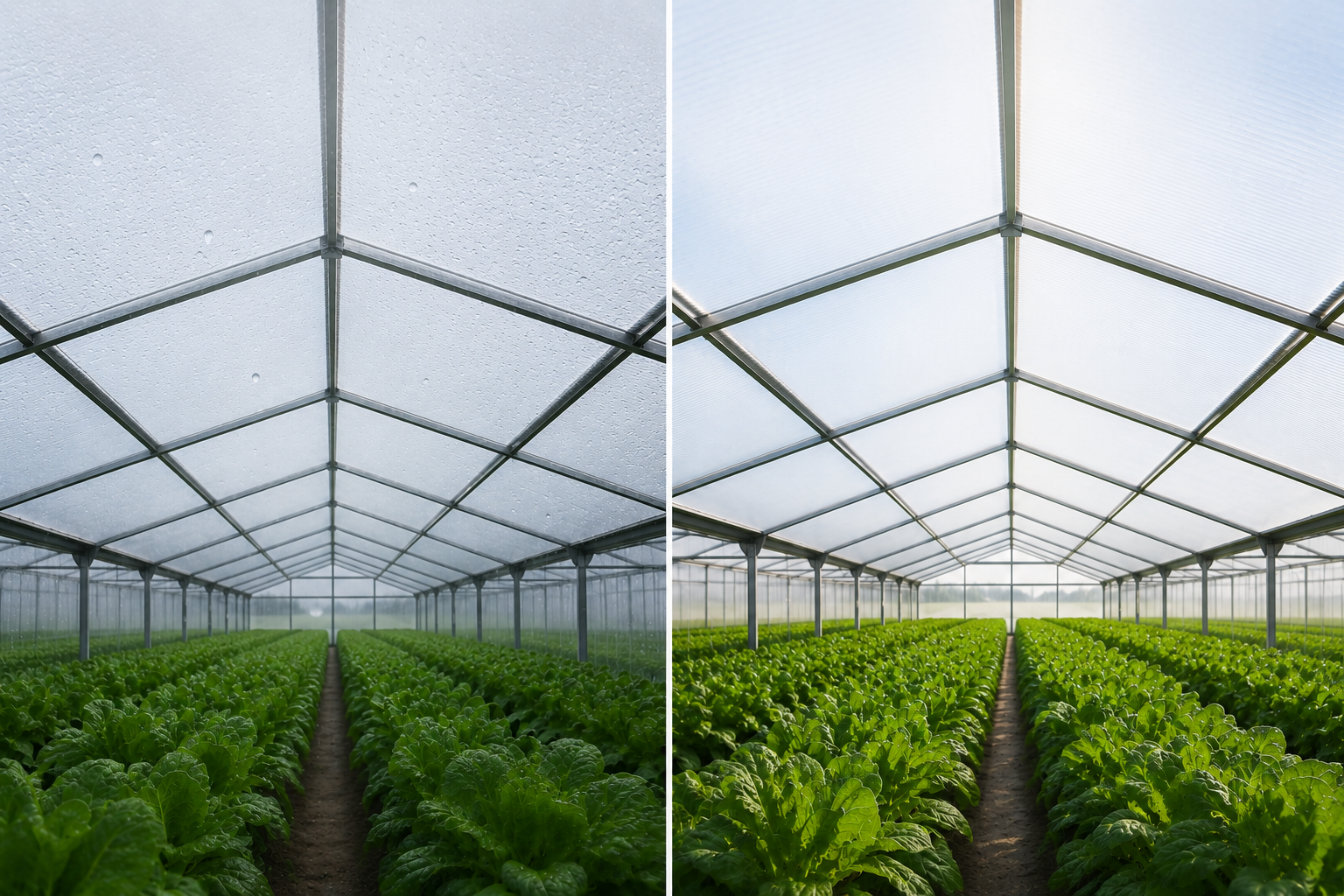
With standard greenhouse coverings, these droplets continue to grow until gravity causes them to fall directly onto the crop. While this may seem harmless, excessive dripping can create several challenges:
- Increased risk of fungal and bacterial diseases
- Uneven moisture distribution
- Reduced light transmission
- Lower crop quality and yield
- Less stable growing conditions
For growers managing high-value crops, even small changes in environmental conditions can impact productivity.
What is anti-Fog technology?
Anti-fog technology is designed to minimize the formation of water droplets on the interior surface of greenhouse coverings. Instead of forming individual droplets, moisture spreads into a thin, transparent film of water. This film allows water to flow toward drainage points rather than dripping directly onto plants.
The result is a cleaner, more uniform growing environment.
Standard coverings vs. anti-fog coverings
Standard greenhouse coverings
Water forms visible droplets.
Condensation accumulates over time.
Droplets can fall directly on crops.
Reduced light transmission due to scattered water droplets.
Increased risk of disease development.
Anti-fog greenhouse coverings
Moisture spreads evenly across the surface.
Reduced dripping over crops.
Improved light transmission.
Healthier growing conditions.
Why light transmission matters
Many growers associate condensation only with moisture management, but it also affects available light.
Thousands of water droplets on the interior surface can scatter and block incoming sunlight. Over time, this reduction in usable light may affect photosynthesis and crop development. Anti-fog technology helps maintain a clearer surface, allowing more light to reach the crop canopy.
Supporting crop health
Excess moisture on leaves, flowers, and fruit can contribute to the development of common greenhouse diseases. By reducing water dripping onto crops, anti-fog coverings help growers create a more controlled environment and support healthier plant growth.
This benefit is particularly valuable for:
Cannabis cultivation
Tomato production
Berry production
Ornamentals
Propagation facilities
High-value greenhouse crops
Is anti-fog technology worth it?
For commercial growers, greenhouse coverings should do more than simply provide shelter. The right covering should help maximize light, support climate control, reduce disease pressure, and improve operational efficiency. Anti-fog technology is a simple but effective way to enhance greenhouse performance while helping protect crop quality and yield.
Looking for greenhouse covering solutions?
KLAR Multiwall Polycarbonate solutions are designed to help growers optimize light transmission, thermal performance, and condensation control in demanding greenhouse environments.
Contact our team to learn more about greenhouse solutions designed for commercial growers.